Why Testosterone Naturally Shifts After 40
8 min read

After 40, total testosterone drops roughly 1 to 2 percent per year. But free testosterone often falls faster because sex hormone-binding globulin rises with age. Sleep, body composition, and stress all push the numbers around considerably. Understanding the mechanism helps you focus on what is actually moveable.
Keith Weller, USDA ARS / Public domain / via Wikimedia Commons
The Numbers Behind the Decline
Research from the Massachusetts Male Aging Study tracked men over decades and confirmed total testosterone falls roughly 1 to 2 percent per year starting in the late 30s to early 40s. That sounds alarming until you look at the actual distribution. Some men at 60 test higher than others at 45. The range considered normal for total testosterone runs from about 300 to 1,000 ng/dL, and where you land depends on more variables than age alone.
The part that catches most men off guard: total testosterone is not the whole picture. A protein called sex hormone-binding globulin (SHBG) increases with age and binds tightly to testosterone, making it unavailable to cells. So even when total testosterone stays in a reasonable range, the free fraction, the portion your body can actually use, tends to drop faster. Some men experience the effects of declining free testosterone while their total numbers still look fine on paper. A complete hormone panel includes both values.
What Is Actually Driving the Change
The process starts well upstream from the testes. The hypothalamic-pituitary-gonadal axis, a feedback loop connecting your brain, pituitary gland, and testes, governs testosterone production. Luteinizing hormone (LH) signals Leydig cells in the testes to produce testosterone. With age, Leydig cell number and responsiveness both decline, so even with adequate LH signaling, output falls.
At the same time, the hypothalamus becomes somewhat less sensitive to feedback signals. The whole system gets noisier. Think of it like a thermostat that still functions but with slightly less precision than it had at 25. The result is a lower baseline output and a less robust hormonal response under stress or poor sleep.
This is biology, not a malfunction. The shift is gradual and highly variable between men. But knowing the mechanism matters because it points toward levers that are actually moveable, rather than chasing numbers that are largely outside your control.
The Factors Men Can Actually Move
Age sets a floor. What you do with sleep, body composition, stress, and training determines how far above that floor you operate. For most men, lifestyle variables account for more year-to-year variation than the aging process itself does in a given year.
- Sleep. Testosterone is produced primarily during sleep, concentrated in the early cycles. Men who consistently get fewer than 6 hours show measurably lower morning testosterone than those sleeping 7 to 9 hours. Research has shown that one week of restricted sleep in healthy men reduced testosterone by 10 to 15 percent. That is a larger short-term swing than most men lose to a full decade of aging.
- Body composition. Adipose tissue contains an enzyme called aromatase that converts testosterone to estradiol. Excess visceral fat accelerates this conversion, which matters for supporting testosterone levels already within a normal range. Reducing visceral fat is one of the higher-leverage changes a man in his 40s or 50s can make.
- Chronic stress. Cortisol and testosterone have an inverse relationship. Sustained high cortisol suppresses LH signaling and competes with testosterone at the receptor level. This is not speculative physiology, it is well-documented hormonal competition.
- Alcohol. Regular heavy drinking suppresses the HPG axis directly. Moderate intake has smaller but measurable effects on testosterone levels already within a normal range.
- Resistance training and recovery. Consistent lifting helps maintain healthy testosterone levels. Overtraining without adequate recovery suppresses them. Most men underestimate the recovery side of that equation.
What Low Testosterone Actually Means
Men often ask us whether their fatigue, shifting body composition, or slower gym recovery mean they have low testosterone. The honest answer: these symptoms overlap with a long list of other variables, and bloodwork is the only reliable way to know where you actually stand.
Most labs flag total testosterone below 300 ng/dL as below the normal range. Free testosterone thresholds vary by lab and measurement method. Before drawing conclusions from a single number, know that testosterone is highest in the morning and varies considerably day to day. A single midday blood draw is a weak data point. Two or three morning tests taken consistently give a clearer baseline than any one number.
Symptoms that often correlate with testosterone levels already within a normal range include reduced energy, shifts in body composition, and slower recovery. None of these are diagnostic on their own. They are signals worth investigating with a physician, not conclusions worth acting on without data.
What the Research Shows About Nutritional Support
Several nutrients have solid mechanistic rationale and human study data behind their role in hormonal health. These are not exotic compounds. They are ingredients with enough research to have earned a seat in a well-built formula.
- Zinc is a required cofactor in testosterone biosynthesis. Deficiency is directly associated with lower testosterone levels in multiple studies. Most Western men consume adequate dietary zinc, but absorption varies, and men training hard and sweating regularly may lose more than food alone replaces.
- Vitamin D3 operates more like a hormone than a vitamin. Receptors for it are found throughout the testes and pituitary gland. Men with adequate vitamin D levels tend to maintain testosterone in a healthier range compared to those who are deficient, which describes a significant portion of men living above the 35th parallel during winter months.
- Ashwagandha (Withania somnifera) has been studied in randomized controlled trials specifically for its effects on testosterone in men. One published trial found measurable improvements in testosterone levels already within a normal range among men taking standardized root extract compared to placebo.
- Boron influences SHBG activity in a way that may help support the free testosterone fraction already within normal ranges.
- Fenugreek seed extract has shown support for free testosterone levels in men doing consistent resistance training across several human trials.
How the Wild Bison Formula Fits Into This
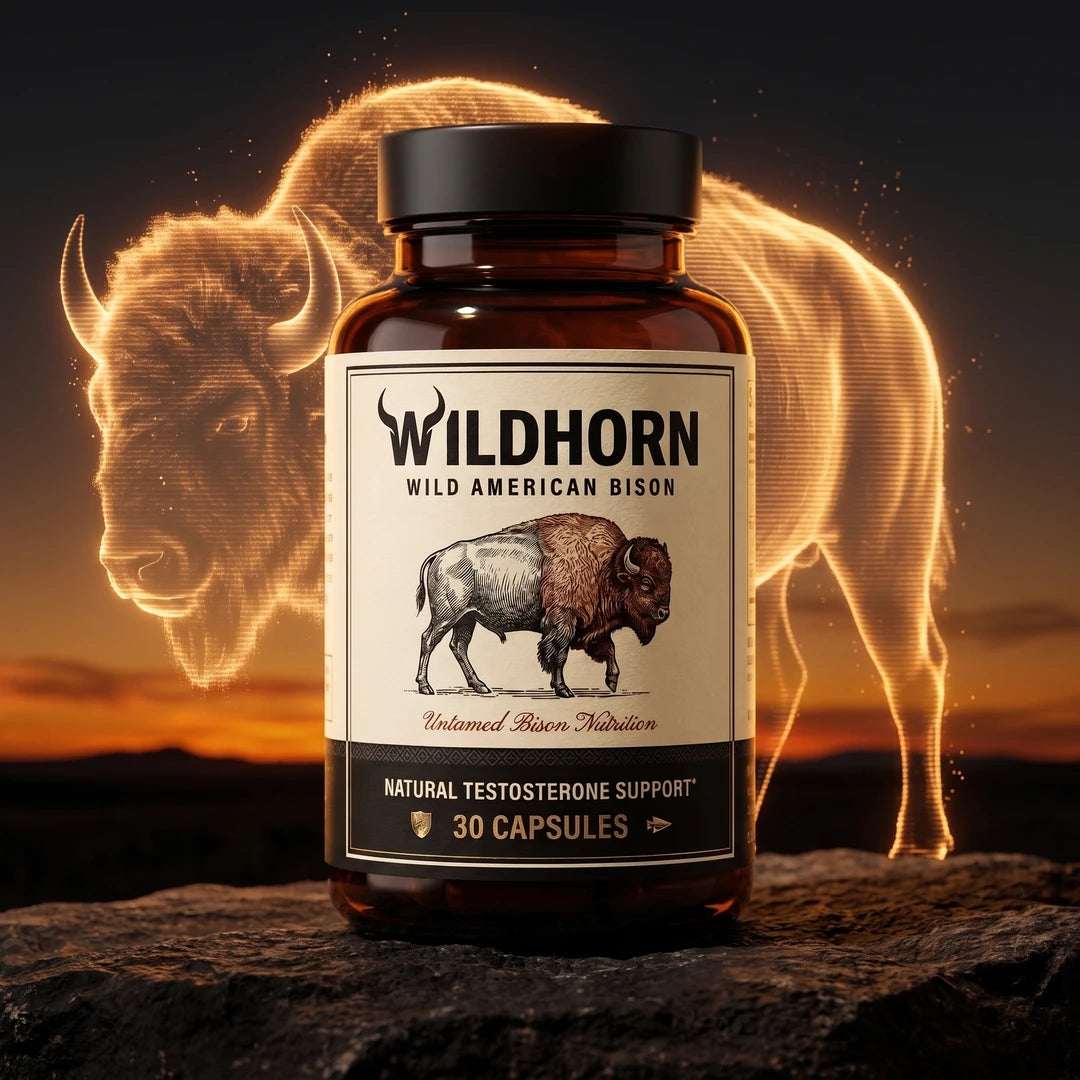
Customers often ask us what separates Wild Bison from the dozens of testosterone-support products on the market. Our answer is specificity. We did not build a kitchen-sink formula with 30 ingredients dosed too low to do anything meaningful. The stack is built around zinc, vitamin D3, ashwagandha, and boron, at doses that reflect the actual human research rather than label decoration.
Wild Bison is designed to support healthy testosterone levels already within a normal range. It is built for men who already have the basics in place: reasonable sleep, some resistance training, body composition they are actively managing. In our formula, every ingredient listed has a documented reason for being there and a dose that matches what the research used. Nothing is filler.
If you want to see the full ingredient breakdown, the Wild Bison testosterone support formula page has the complete stack and sourcing rationale.
A Practical Framework for Men Over 40
If supporting your hormonal health going forward is the goal, a reasonable starting point looks like this.
Get bloodwork. Total testosterone, free testosterone, SHBG, and estradiol give you an actual baseline. Add vitamin D if you have not tested it recently. These are not expensive panels, and they turn guesswork into a plan.
Protect your sleep. Seven to nine hours, consistent wake time, cool and dark room. This is not optional infrastructure. It is the primary production window for testosterone, and no supplement replaces it.
If there is meaningful visceral fat to lose, address it. Not for aesthetics, but for aromatase control and insulin sensitivity, both of which help support hormonal balance already within a normal range.
Train with weights two to four times per week. Build in enough recovery that you are making progress rather than just accumulating fatigue. More is not better past the recovery threshold.
Then, once those foundations are in place, consider targeted nutritional support from a formula built on ingredients that have earned their position in the research. That is where supplementation has the most to offer, as part of a complete approach, not as a substitute for one.
Frequently asked questions
Does testosterone always decline with age?
Total testosterone tends to fall gradually after the early 40s, averaging roughly 1 to 2 percent per year. But the range between individual men is wide. Sleep, body composition, and training habits significantly influence where you land. Age sets a direction, not a fixed destination.
What is the difference between total and free testosterone?
Total testosterone measures all testosterone in your blood. Free testosterone is the fraction not bound to proteins like SHBG and is available to interact with tissues. As SHBG rises with age, free testosterone tends to fall faster than total testosterone, which is why some men notice changes in energy and recovery while their total numbers still look acceptable on a standard panel.
Can supplements help support testosterone levels?
Certain nutrients are directly involved in testosterone biosynthesis and HPG axis function. Zinc, vitamin D3, ashwagandha, and boron have human study data supporting their role in helping maintain testosterone levels already within a normal range. No supplement replaces the foundational work of sleep, resistance training, and body composition management.
How do I know if my testosterone levels are actually low?
Bloodwork is the only reliable answer. Total testosterone, free testosterone, and SHBG together give a complete picture. Symptoms like fatigue, reduced recovery, and body composition changes are non-specific and share causes with many other variables. Two or three morning tests taken consistently are more reliable than a single draw.
Is ashwagandha safe for daily use?
Ashwagandha has a long history of traditional use and multiple published human trials at doses of 300 to 600 mg of root extract per day. It is generally well tolerated in healthy adults. If you take medications or have a health condition, discuss any new supplement with your doctor before starting.
These statements have not been evaluated by the Food and Drug Administration. This product is not intended to diagnose, treat, cure, or prevent any disease.
Written by The Wildhorn Desk, Men's Health Editor.